
Getting a raw farm product from a small growing region to a factory on the other side of the world takes far more than a single transaction. Behind every shipment of bulk agricultural goods sits a chain of sourcing decisions, quality checkpoints, paperwork, and logistics coordination that most buyers never see directly.
Two shipments of the same commodity, from the same country, can still arrive at very different quality levels depending on how well each step in this chain was managed. A missed moisture check, a delayed export certificate, or a poorly packed container can turn a good harvest into a rejected shipment at the destination port. This is exactly why sourcing and export management deserve as much attention as the commodity itself.
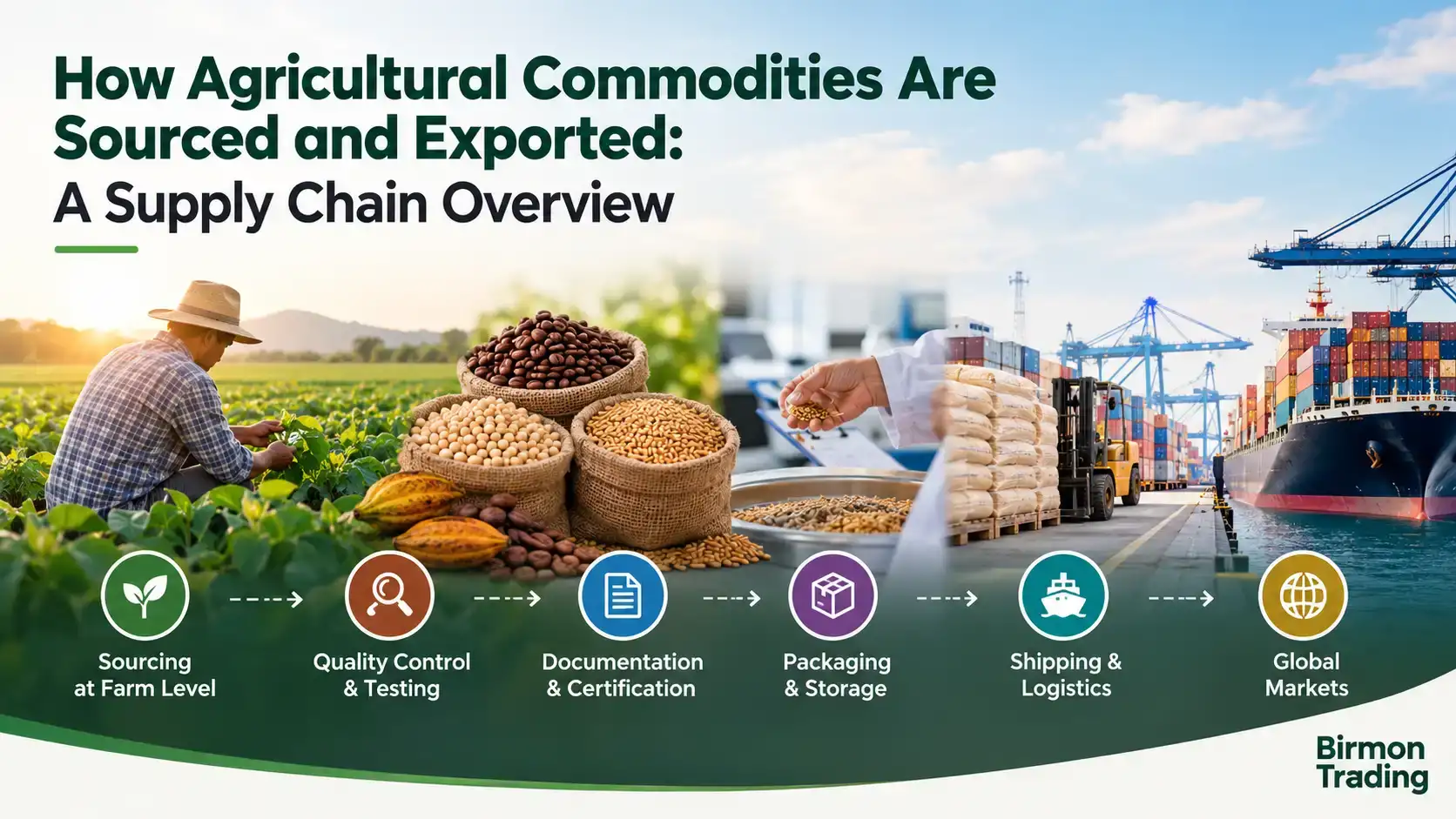
This guide breaks down how agricultural commodities actually move from farm to export terminal. It covers how sourcing works on the ground, what documentation and certifications matter, how packaging and shipping decisions get made, and why a strong sourcing process protects both the exporter and the buyer.
Sourcing rarely means buying directly from a single large farm. Most agricultural commodities get sourced through one of three common structures.
Commodities like cocoa and coffee often rely heavily on cooperatives and local agents, since production is spread across thousands of small farms rather than a handful of large estates. Commodities like soybean and wheat, grown on larger commercial farms in countries such as Brazil or the United States, tend to move through more direct sourcing relationships.
Before any commodity moves toward export, it goes through a series of checks that protect both the seller's reputation and the buyer's investment.
Every batch gets tested for moisture content, since too much moisture leads to mold, spoilage, or weight loss during a long sea voyage. Purity checks look for foreign matter such as stones, husks, or damaged beans that would lower the overall grade.
Most commodities follow grading systems tied to size, color, defect count, and consistency. Robusta coffee beans, for example, get graded on defect count per sample, bean size, and moisture level before export contracts are finalized.
For many large orders, buyers request a pre-shipment sample before the full container gets loaded. This lets the buyer confirm quality against contract specifications before committing to the full shipment, reducing the risk of disputes after arrival.
Export paperwork is where many first-time buyers get overwhelmed, but the core documents follow a consistent pattern across most agricultural commodities.
| Document | Purpose |
|---|---|
| Certificate of Origin | Confirms the country where the commodity was grown or produced |
| Phytosanitary Certificate | Confirms the shipment is free of pests and plant diseases |
| Quality or Inspection Certificate | Confirms the shipment meets the agreed grade and specification |
| Bill of Lading | Serves as the shipping contract and proof of goods loaded onto the vessel |
| Commercial Invoice and Packing List | Details the value, quantity, and packaging breakdown of the shipment |
| Fumigation Certificate | Confirms treatment against insects for commodities packed in jute or woven bags |
Missing or incorrect paperwork is one of the most common reasons a shipment gets delayed at customs, sometimes for weeks. Working with an experienced trading partner who handles this documentation correctly the first time saves buyers real time and money.
Packaging decisions depend heavily on the commodity itself, since each product reacts differently to moisture, pressure, and temperature during a long shipment.
Cocoa beans typically travel in breathable jute bags, since raw beans need airflow to prevent condensation buildup inside a sealed container. Cocoa butter, on the other hand, ships in sealed cartons or blocks, since it needs protection from heat and contamination rather than airflow. Tapioca starch usually moves in multi-layer paper or woven polypropylene bags that guard against moisture absorption, which can clump the starch and reduce its usability. Peanut shipments require careful attention to aflatoxin risk, so packaging often includes moisture barriers and strict container hygiene checks before loading.
Once a commodity clears quality checks and paperwork, it moves into the logistics stage.
Most agricultural commodities move in standard 20-foot or 40-foot shipping containers, loaded with bagged product. Trading companies consolidate smaller lots from multiple farms or cooperatives into full container loads, which lowers the shipping cost per ton for the buyer.
Buyers and sellers agree on shipping terms using standardized trade rules known as Incoterms. FOB, or Free on Board, means the seller covers costs up to loading the goods onto the vessel, after which the buyer takes responsibility. CIF, or Cost, Insurance, and Freight, means the seller covers shipping and insurance all the way to the destination port. Choosing the right term affects who carries the risk at each stage of the journey.
Once a shipment reaches the destination port, it clears customs using the documents prepared earlier, then moves to the buyer's warehouse or processing facility. Delays at this stage are usually tied to paperwork issues rather than the physical shipment itself, which is why accurate documentation matters as much as the product quality.
This same sourcing and export structure applies well beyond the commodities discussed above. Sugar, cotton, rice, wheat, and soybean all move through comparable stages of farm-level sourcing, quality grading, documentation, and container shipping, even though the specific certificates and packaging details shift from one commodity to another. Cashew nuts require extra attention to shell moisture and pest control, while chili and other dried spices need strict handling to prevent color loss and contamination during transit. Regardless of the commodity, the underlying goal stays the same: move a raw farm product from origin to destination without losing quality or triggering costly delays along the way.
Sourcing and exporting agricultural commodities is a layered process that starts long before a container reaches a port. It begins with how a trading company builds relationships with farmers, cooperatives, or local buying agents, continues through moisture testing, grading, and sample approval, and depends heavily on accurate documentation that satisfies customs authorities on both ends of the shipment.
Across this guide, each of these stages came into focus in detail, from farm-level sourcing structures and quality control checkpoints to the documentation every shipment needs, packaging choices suited to specific commodities, and the shipping decisions that determine who carries risk at each point in the journey. A single weak link anywhere in this chain, whether it is a missing certificate or poorly chosen packaging, can turn a strong harvest into a costly delay or rejected shipment.
For buyers, understanding this process is not just background knowledge. It shapes how confidently a business can rely on its supply chain, plan production schedules, and avoid the disruptions that come from working with an inexperienced or poorly organized supplier.
Sourcing and exporting agricultural commodities correctly takes experience, verified farm relationships, and careful attention to documentation at every stage. Birmon Trading manages this entire process end to end, so buyers receive shipments that meet specification without the delays or surprises that come from working with an unreliable supply chain. Reach out to our team to discuss your sourcing requirements and see how we manage quality and logistics from farm to port.
Getting a raw farm product from a small growing region to a factory on the other side of the worl
READ FULLGlobal trade runs on a small group of raw farm products that show up in almost every industry. Th
READ FULLEvery day, farms around the world grow raw goods that feed major industries. These raw goods are
READ FULL