

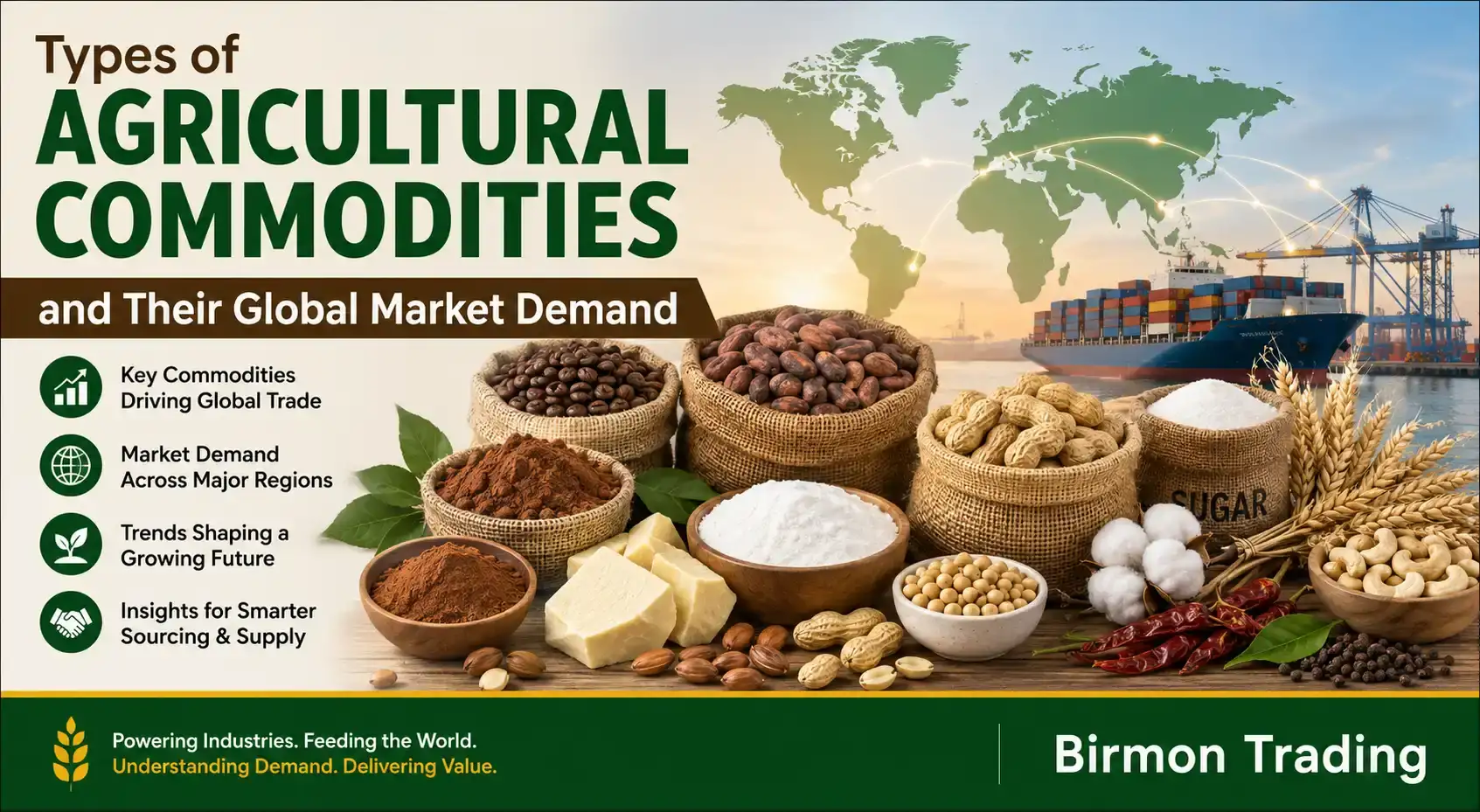
Global trade runs on a small group of raw farm products that show up in almost every industry. These raw goods fall under what the trade calls many different types of agricultural commodities sold in bulk across international markets, and each one follows its own demand pattern based on where it grows, how it gets used, and which countries buy the most of it. Coffee demand looks nothing like peanut demand, and cocoa demand moves on a completely different cycle than starch demand.
Understanding these demand patterns matters for anyone who buys, sells, or processes raw agricultural goods. The global coffee market alone is now valued at over 300 billion US dollars and keeps climbing as coffee shop culture spreads into new regions. Cocoa markets went through wild price swings between 2024 and 2026, showing just how sensitive some commodities are to a single harvest season. A processor who tracks these shifts can plan purchases better than one who only watches the price tag.
This guide walks through the main types of agricultural commodities traded worldwide and looks at what drives demand for each one. It covers where the biggest markets sit today, which regions are growing fastest, and why certain commodities keep climbing in demand year after year while others stay flat.
Agricultural commodities generally split into two broad groups based on how they get processed after harvest.
Both groups get traded internationally, but demand for each moves differently. Raw commodities respond quickly to harvest size and weather, sometimes swinging in price within a single quarter. Processed derivatives respond more to manufacturing demand, since factories only order what their production schedule needs, which tends to smooth out some of the volatility seen further up the supply chain.
The global coffee market reached roughly 300 billion US dollars in 2026 and is forecast to grow at more than 5 percent a year through the next decade. Europe currently holds the largest share of coffee demand, helped by a long-established coffee culture and major chains that trace their roots back to the region. Asia Pacific is catching up fast, with rising incomes in China and India fueling some of the quickest growth anywhere in the world.
Robusta coffee beans have picked up market share in recent years, now accounting for a much larger share of global exports than a decade ago. Vietnam remains the top Robusta producer and exporter, and demand keeps rising from instant coffee brands and espresso blend makers who want a bolder cup at a lower cost than Arabica. Arabica still commands the premium end of the market, particularly in specialty coffee shops and single-origin retail, where buyers pay extra for smoother, more delicate flavor notes.
Cocoa has gone through one of the most volatile stretches in its trading history. Prices spiked to record highs in early 2025 before falling sharply as West African supply recovered, and the market is now easing toward a small surplus for the first time in several seasons. Even with that price correction, the underlying chocolate confectionery industry keeps growing and is estimated to be worth well over 140 billion US dollars a year, which keeps long-term demand for cocoa inputs on a rising path.
Demand splits across three related products. Raw cocoa beans feed grinding and processing plants directly, and roughly 5 million metric tons get produced globally each season. Cocoa powder demand stays closely tied to bakery, beverage, and dairy manufacturing, where buyers need a shelf-stable cocoa input that performs consistently across large production runs. Cocoa butter pulls demand from two very different industries at once, chocolate manufacturing and cosmetics, which keeps its market broader and somewhat more resilient than the other two.
The global tapioca starch market sits in the range of 8 to 9 billion US dollars today and continues to grow at a pace of roughly 5 to 6 percent a year. Southeast Asia, led by Thailand and Vietnam, remains the production and export center of the industry, while China stands out as the single largest buyer, pulling in hundreds of thousands of tons a month to feed its paper, textile, and bioplastic manufacturing base.
Food applications still account for the majority of tapioca starch demand, but industrial buyers outside food have become a meaningful part of the market too, now representing more than a quarter of global consumption. Clean-label and gluten-free formulation trends across North America and Europe continue to push manufacturers toward tapioca starch as a natural alternative to synthetic thickeners, adding a second, steadier layer of demand on top of its traditional industrial uses.
Global peanut demand has been rising alongside growing interest in plant-based protein, with the worldwide peanut market now valued close to 90 billion US dollars. Asia Pacific leads global consumption by a wide margin, with China and India together accounting for the largest single block of demand, while North America and Europe drive much of the growth in higher-value peanut products like peanut butter and protein snacks.
Roughly 70 percent of global peanut demand goes toward food processing, including confectionery, snacks, and spreads, while around one-fifth goes toward oil extraction. Peanut butter alone has become one of the fastest-growing segments, as manufacturers roll out protein-focused and clean-label versions to meet rising demand from health-conscious buyers in North America and Europe.
Sugar demand stays consistently high across the beverage and confectionery industries, with Brazil and India producing the largest volumes and much of that supply feeding both domestic consumption and export markets across Asia and the Middle East.
Cotton demand tracks closely with the global textile and apparel industry, and China remains the largest single consumer, processing raw cotton into yarn and fabric for both its domestic market and export-focused manufacturing base.
Rice and wheat sit at the center of global food security, since both are staple grains for a large share of the world's population. Asia drives the bulk of rice demand, while wheat demand spreads more evenly across Europe, the Middle East, and North Africa, regions that depend heavily on imports to meet local consumption.
Soybean demand has grown into one of the largest stories in global agricultural trade, driven mainly by China's need for animal feed and cooking oil. This single demand source has reshaped shipping routes and trade relationships between soybean-exporting countries and Asian buyers over the past two decades.
Cashew nuts continue to gain ground in the premium snack food segment, particularly across North America and Europe, where demand for higher-value nut snacks keeps expanding faster than more traditional peanut or almond categories.
Chili and spices remain in steady demand across food processing and seasoning industries worldwide, with consumption spread fairly evenly across regions rather than concentrated in one dominant market, which gives this category a more stable demand profile overall.
| Commodity | Leading Demand Regions | Demand Trend |
|---|---|---|
| Robusta Coffee | Asia Pacific, Europe | Rising |
| Arabica Coffee | Europe, North America | Stable to rising |
| Cocoa Beans | Europe, Asia Pacific | Rising |
| Cocoa Powder | Global, food manufacturing hubs | Stable to rising |
| Cocoa Butter | Europe, North America | Rising |
| Tapioca Starch | China, Southeast Asia, Europe | Rising |
| Peanut | Asia Pacific, North America | Rising |
| Sugar | Asia, Middle East | Stable |
| Cotton | Asia | Stable |
| Rice | Asia | Rising |
| Wheat | Europe, Middle East, North Africa | Rising |
| Soybean | Asia Pacific | Rising |
| Cashew Nuts | North America, Europe | Rising |
| Chili and Spices | Global | Stable |
A few forces sit behind almost every rising demand trend across agricultural commodities.
As populations grow, basic food demand grows with them. As incomes rise, especially in emerging markets across Asia, people shift toward higher-value foods like chocolate, coffee, and packaged snacks instead of relying only on staple grains. This shift is a major reason cocoa, coffee, and cashew demand keep outpacing simple population growth.
Commodities that serve multiple industries at once tend to see steadier long-term demand. Tapioca starch and cocoa butter both benefit from this pattern, since a slowdown in one industry, such as food manufacturing, often gets offset by continued demand from another, such as cosmetics or industrial adhesives.
As more people move into cities, packaged and processed food consumption rises sharply. This directly increases demand for ingredients like starch, sugar, and cocoa derivatives, which show up in nearly every packaged food product sold on modern store shelves.
Large manufacturers increasingly ask for traceable, sustainably sourced commodities, particularly across cocoa and coffee supply chains. This does not reduce overall demand, but it does shift demand toward suppliers who can prove responsible sourcing practices, which is becoming a bigger factor in long-term buyer relationships.
Every agricultural commodity follows its own demand story, shaped by the industries it feeds and the regions that consume it most. Coffee demand keeps climbing on the back of a 300 billion dollar global market and fast-growing Asian consumption. Cocoa demand grows alongside a chocolate confectionery industry worth well over 140 billion dollars a year, even as raw cocoa prices swing sharply from season to season. Tapioca starch stays on a steady growth path because it serves food, paper, textile, and bioplastic industries all at once, and peanut demand keeps rising as plant-based protein trends push global consumption higher.
This guide covered the major forces behind these trends, including population growth, rising incomes, industrial diversification, urbanization, and growing pressure around sustainable sourcing. Together, these forces explain why some commodities keep climbing in demand year after year while others hold steady at a consistent baseline.
For any business that depends on raw agricultural inputs, understanding these demand patterns is just as important as tracking prices. Knowing where demand is heading helps buyers plan ahead, lock in supply at the right time, and avoid getting caught off guard by sudden market shifts.
Reading demand trends is only useful if you have a sourcing partner who can act on them. Birmon Trading stays close to market movement across our full product range, so our buyers get consistent supply even as global demand shifts. If your business needs a reliable partner who understands where these markets are heading, reach out to our team today.
Getting a raw farm product from a small growing region to a factory on the other side of the worl
READ FULLGlobal trade runs on a small group of raw farm products that show up in almost every industry. Th
READ FULLEvery day, farms around the world grow raw goods that feed major industries. These raw goods are
READ FULL