
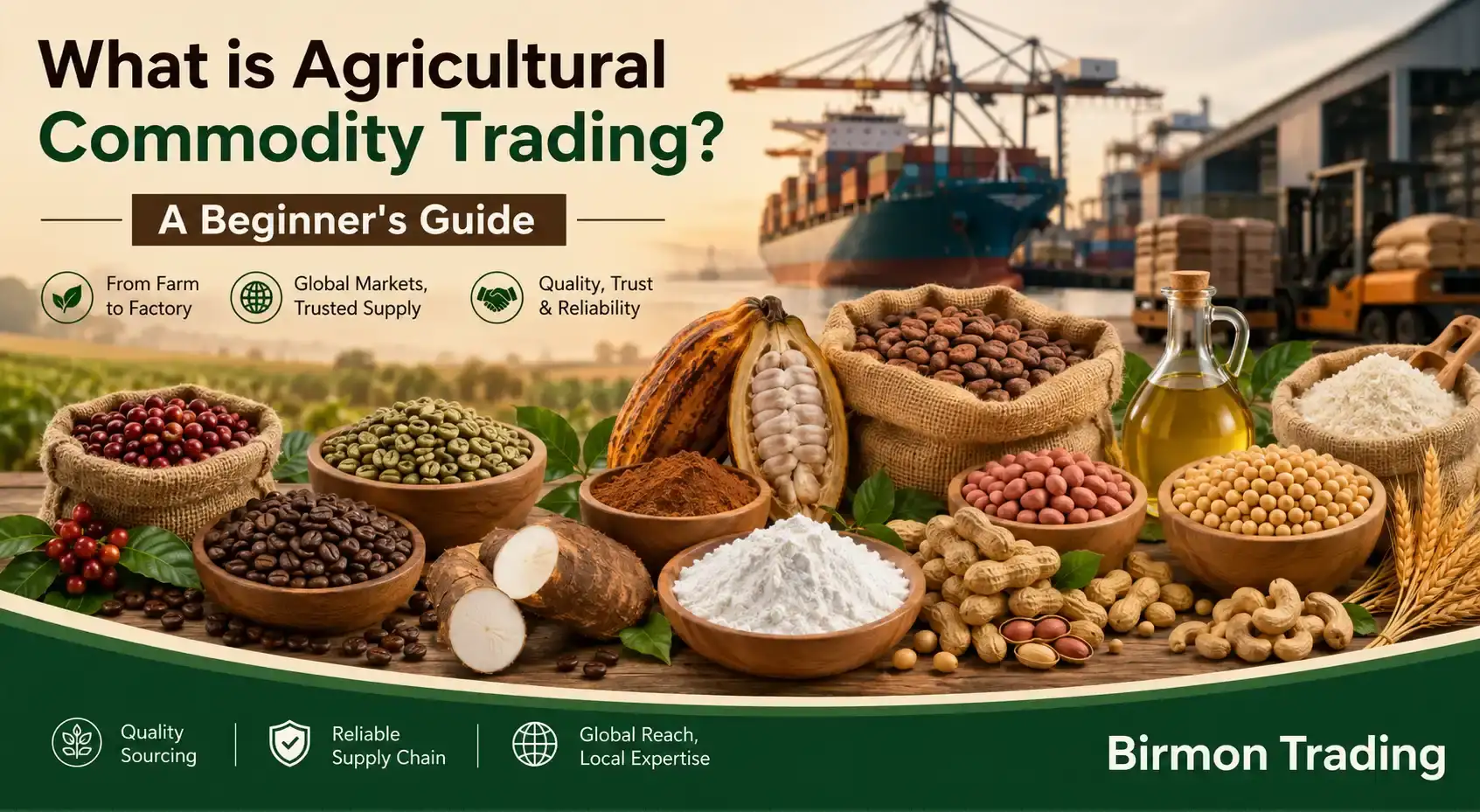
Every day, farms around the world grow raw goods that feed major industries. These raw goods are called agricultural commodities. A single bag of coffee beans or a block of cocoa butter often crosses three or four countries before it reaches a factory. This journey includes farming, drying, grading, and shipping. Each step adds cost and value, and each step needs a different set of skills to manage.
Most people use products made from agricultural commodities every single day, often without knowing it. A cup of coffee, a chocolate bar, a bag of chips fried in peanut oil, or even the starch used in a packaged snack all begin as raw farm crops. These crops then enter a large trading network that links small farms to large manufacturers across different continents. This network depends on trust between buyer and seller, strict quality checks at every stage, and a supply chain that does not break down when one region has a bad season.
This guide breaks down what agricultural commodity trading actually means. It looks at how the trade works from farm to factory, which commodities move in the highest volumes, and what causes their prices to jump or drop within weeks. By the end, you will have a clear, practical picture of this industry instead of just textbook definitions.
An agricultural commodity is a raw farm product sold in bulk, usually measured in tons rather than units. Buyers do not choose these goods based on brand names the way they would choose a packaged snack. They choose based on grade, moisture content, size, and country of origin. A shipment of Grade 1 cocoa beans from one exporter should meet the same standard as Grade 1 cocoa beans from another exporter, even if the farms are thousands of miles apart.
Traders usually split commodities into two broad groups.
Companies in the agricultural trading space work almost entirely within the soft commodity group. This is where raw crops from small and mid-size farms get consolidated into shipment-ready volumes for global buyers.
Agricultural commodities sit behind products most people buy without a second thought. Food manufacturers use them to make packaged snacks and baked goods. Beverage companies rely on them for coffee, tea, and flavored drinks. Cosmetic brands use certain oils and butters in creams and soaps. Textile mills depend on cotton, and paper mills depend on starch-based binders.
A shortage in just one growing region can push prices up worldwide within a single season. When Ivory Coast has a weak cocoa harvest, chocolate manufacturers everywhere feel it, not just buyers in West Africa. This ripple effect is exactly why manufacturers avoid sourcing directly from scattered, unverified farms. They prefer working with an established trading partner who already understands quality grading, export documentation, and shipping timelines. This cuts down risk and keeps supply predictable, season after season.
Some agricultural commodities see steady, high-volume demand year after year. Here is a closer look at the ones that move the most product globally.
Coffee is one of the most heavily traded soft commodities on earth, second only to a handful of other agricultural goods in total trade value. Buyers usually pick between two main species. Robusta coffee beans carry a stronger, more bitter taste and a higher caffeine content, which makes them a favorite for instant coffee and strong espresso blends. Arabica beans have a smoother, sweeter profile and typically cost more per ton.
Cocoa anchors the entire chocolate and confectionery industry. This starts with raw cocoa beans, the unprocessed seed that every chocolate product begins with. From there, processors extract cocoa powder for baking mixes and drink powders, and cocoa butter, a fat used in chocolate bars, lotions, and even certain pharmaceutical products.
Tapioca starch, extracted from the cassava root, shows up in food thickeners, paper coatings, textile sizing, and industrial adhesives. Because it serves so many unrelated industries at once, demand for tapioca starch rarely drops even when one sector slows down.
Peanuts get traded both as a whole food product and as a raw material for peanut oil extraction. Demand for peanut stays consistent because it fits into snack food, cooking oil, and animal feed markets all at once.
Beyond these, a handful of other commodities round out the global agricultural trade picture. Sugar feeds the beverage and confectionery industry at massive scale. Cotton supplies the textile industry with its most basic raw fiber. Rice and wheat remain staple food grains traded in some of the highest volumes on the planet. Soybean supplies both cooking oil and animal feed protein, while cashew nuts and dried chili and spices support the snack food and seasoning industries respectively. Together, these commodities form the backbone of global food and industrial supply chains.
| Commodity | Type | Common Uses |
|---|---|---|
| Robusta Coffee | Soft commodity | Instant coffee, espresso blends |
| Arabica Coffee | Soft commodity | Specialty and filter coffee |
| Cocoa Beans | Soft commodity | Chocolate, confectionery |
| Cocoa Powder | Processed derivative | Baking, drink powders |
| Cocoa Butter | Processed derivative | Chocolate, skincare, pharmaceuticals |
| Tapioca Starch | Processed derivative | Food thickening, paper, textiles, adhesives |
| Peanut | Soft commodity | Snack food, cooking oil, animal feed |
| Sugar | Soft commodity | Beverages, confectionery |
| Cotton | Soft commodity | Textile fiber |
| Rice | Soft commodity | Staple food grain |
| Wheat | Soft commodity | Staple food grain, flour |
| Soybean | Soft commodity | Cooking oil, animal feed protein |
| Cashew Nuts | Soft commodity | Snack food, confectionery |
| Chili and Spices | Soft commodity | Seasoning, food processing |
The trading process follows a fairly consistent path from farm to buyer, regardless of which commodity is involved.
This chain explains why trading companies matter so much in this industry. They absorb the complexity of dealing with hundreds of small farms so that a single manufacturer overseas can place one order and receive one predictable shipment.
Prices for agricultural commodities move far more often than prices for finished, packaged goods. Six main factors drive most of these price swings.
Weather has a direct, immediate effect on crop output. Heavy rain during harvest can rot beans still drying in the field. A dry spell during the growing season can shrink yield by a large margin. Extreme heat can stress plants enough to reduce both quantity and quality. When a major growing region gets hit by bad weather, global supply drops fast, and prices usually rise within weeks, not months.
Almost every agricultural commodity has a fixed harvest window each year. Right after harvest, supply floods the market and prices often dip. As months pass and stock gets used up before the next harvest, supply tightens and prices climb again. Buyers who understand this cycle can time large purchases to avoid paying peak-season prices.
As populations grow and eating habits shift, demand for raw agricultural inputs shifts with them. Rising chocolate consumption in emerging markets, for example, steadily increases demand for both cocoa beans and cocoa butter. When demand grows faster than farms can supply, prices rise. When demand slows or shifts toward substitute products, prices soften.
Most agricultural commodities get priced in US dollars on international markets, even when the crop is grown and sold in a completely different currency. When a producing country's currency weakens against the dollar, farmers earn less locally even if the dollar price stays flat, which can affect how much they plant the following season. When the importing country's currency weakens, buyers pay more in their own currency for the same shipment.
A new export tax, an import quota, or a fresh trade agreement between two countries can change prices overnight, well before any change in the actual harvest. Export bans during domestic shortages are common in staple grains like rice and wheat, and they can spike global prices within days of an announcement.
Getting a bulk shipment from a farm in one country to a factory in another involves fuel costs, container availability, and port handling fees. When shipping lanes get congested or fuel prices rise, landed cost for the buyer goes up even if the commodity's base price stays the same. In recent years, this factor has become one of the more unpredictable pieces of the total cost picture.
Understanding these six factors helps buyers decide not just what to purchase, but when to purchase it and from which region.
Agricultural commodity trading connects small farms to large factories across the entire globe. It starts with a single crop grown under a specific climate and ends as a finished product used by millions of people every day. Along the way, that crop passes through harvesting, drying or fermenting, grading, export handling, and finally import and processing. Each stage adds cost, and each stage requires its own set of checks to protect quality.
This guide covered the building blocks of the industry, from common high-volume commodities like coffee, cocoa, tapioca starch, peanuts, sugar, cotton, rice, wheat, soybean, and cashew, to the full journey these goods take from farm to factory. It also broke down the six real-world factors, weather, seasonal cycles, demand, currency, government policy, and shipping costs, that cause prices to rise and fall, sometimes within the same week.
Understanding these basics shows just how deeply this industry is woven into daily life, from a morning coffee to a chocolate bar to the packaging on a store shelf. It also gives buyers and businesses a stronger foundation for making smarter sourcing decisions.
Sourcing agricultural commodities the right way takes market knowledge, verified supplier relationships, and consistent quality checks at every stage. Birmon Trading works directly with farmers, processors, and buyers to keep this process smooth, transparent, and reliable. Explore our full range of agricultural commodities to see the quality and variety we offer. If steady supply, fair pricing, and export-ready quality matter to your business, reach out to our team today. We are ready to support your sourcing needs with care and consistency.
Getting a raw farm product from a small growing region to a factory on the other side of the worl
READ FULLGlobal trade runs on a small group of raw farm products that show up in almost every industry. Th
READ FULLEvery day, farms around the world grow raw goods that feed major industries. These raw goods are
READ FULL